

- Visitors judge a website in a fraction of a second, and that first judgement colours how much they trust the company behind it.
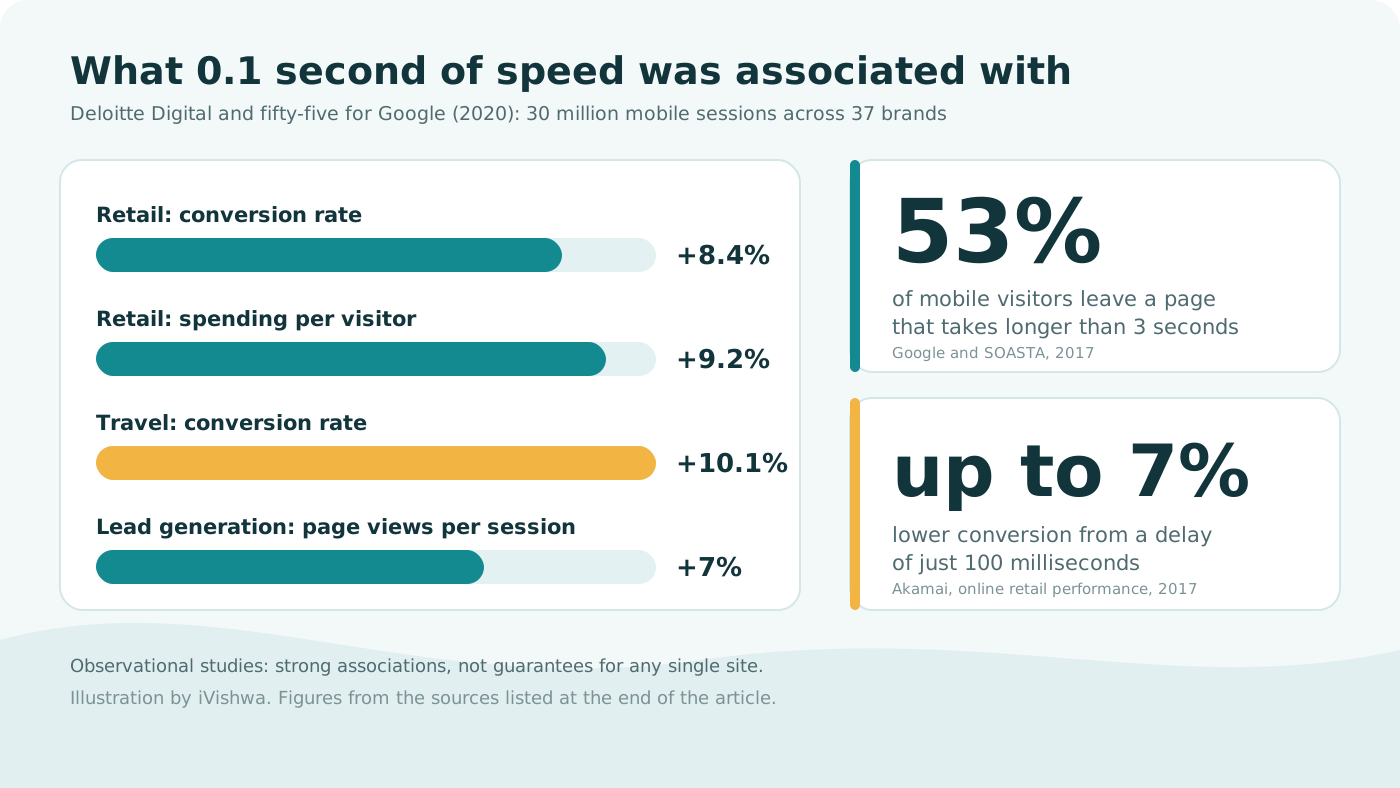
- Speed has a measured commercial effect: Deloitte and Google found that a 0.1 second improvement lifted retail conversion by 8.4%, and Akamai found delays of 100 milliseconds can cost up to 7%.
- Templates and page builders add weight and technical debt that engineered sites avoid, and search engines reward the difference.
- A five-phase process, from research to edge delivery, turns a website from a brochure into a revenue asset.
For two decades the company website was treated as overhead: a brochure handed to a design agency, signed off, and forgotten. For most businesses that is now an expensive habit. Your website is where buyers decide whether you are credible, where search engines decide whether you deserve to be found, and in many companies where the sale actually happens. It deserves to be run like the revenue system it is.
This article is for the people who answer for that: CTOs, marketing leaders, founders and the managers who sign off a rebuild. It explains what the research says about first impressions and speed, where generic websites quietly lose money, what search engines now expect, and how we approach the work at iVishwa. If you sell in the UK, the US, Canada, Australia or Europe, the last section covers what is different in each market.
1. The executive dilemma: brochure or revenue engine?
A brochure site is judged by how it looks to the people inside the company. A revenue engine is judged by what it does for the people outside it: how quickly it loads on a phone in a taxi, how clearly it answers the buyer's first question, and how few steps stand between a decision and an enquiry.
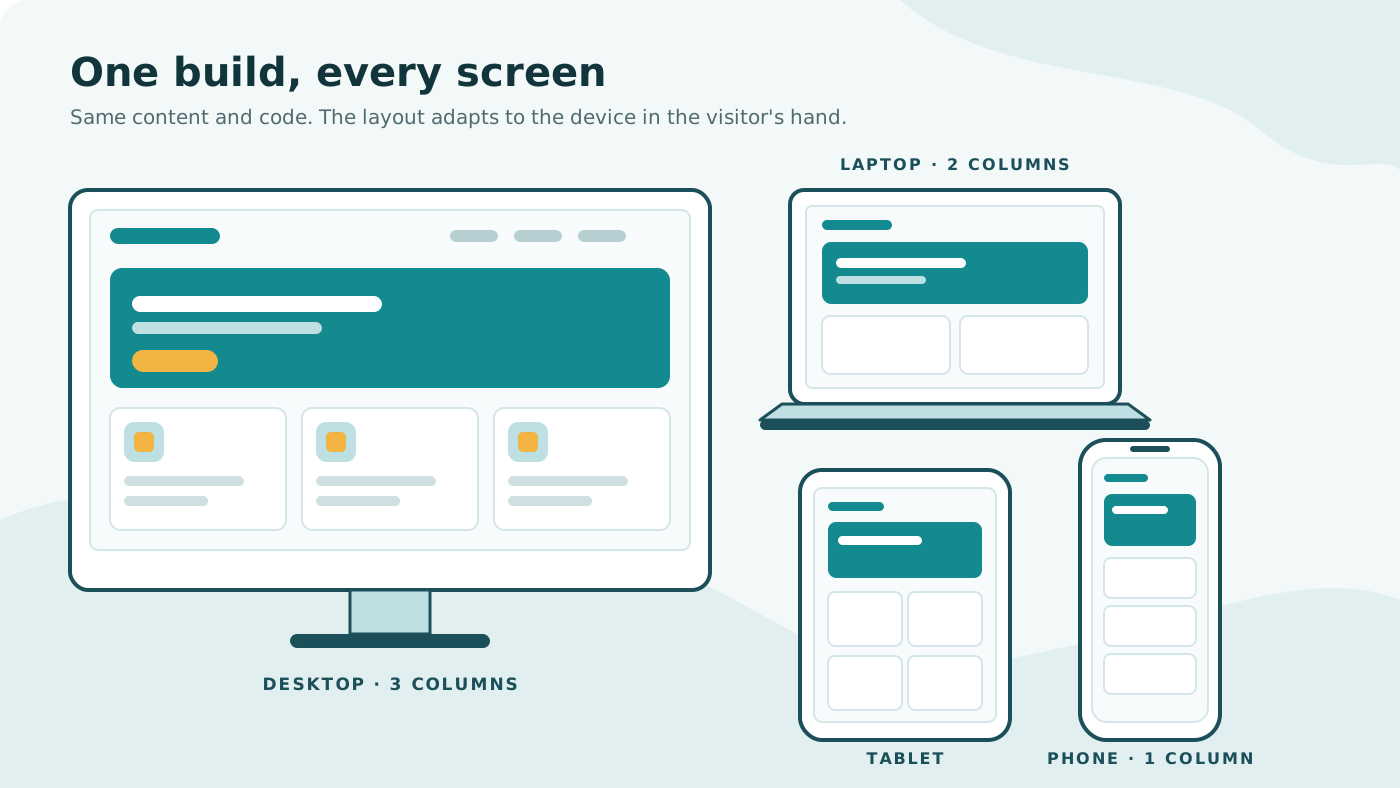
Most buyers meet your company on a screen before they ever speak to anyone. That screen is usually a phone, on an average connection, with a competitor's site one tap away. The question is not "does our site look modern?" It is "does it earn trust quickly, load without friction and make the next step obvious?"
That is a different brief from a design refresh, and it needs different skills: performance engineering, information architecture, search engineering and conversion design, working together from the first sketch rather than patched on at the end.
2. First impressions form faster than you can read this sentence
In a well-known study at Carleton University, researchers found that people can judge the visual appeal of a web page after as little as 50 milliseconds, and that these snap judgements are remarkably consistent between people. That is faster than a blink, and long before anyone has read a word of your copy.
Visual appeal matters commercially because people use it as a shortcut for trust. In the Stanford Web Credibility Project, led by B.J. Fogg, nearly half of the comments people made when judging a site's credibility were about its overall design and look, more than any other factor. "Looks good" was read as "is good".
What happens in the first seconds of a visit can be pictured as three checks:
- Instant impression (under a tenth of a second). Balance, spacing, contrast and typography. This is a gut reaction to order versus clutter.
- Stability check (up to a second). Does the page appear quickly, stay still while it loads, and read easily? Jumping layouts and late-loading fonts feel untrustworthy even when visitors cannot say why.
- Intent check (one to three seconds). Can I tell what this company does, whether it is for me, and what to do next? Clear navigation, visible proof and one obvious call to action decide whether the visit continues.
Bloated themes, mismatched type and layouts that shift as images arrive fail the first two checks before the third even begins. A deliberate visual hierarchy, consistent spacing and a stable layout pass them. None of this is decoration: it is the cheapest trust you can build.
3. The mathematics of latency: how speed turns into revenue
Speed is not a vanity metric. Several large studies have put numbers on what milliseconds are worth:
- 0.1 second, measured across 37 brands. A study by Deloitte Digital and fifty-five for Google analysed 30 million mobile sessions. Improving load speed by just 0.1 second was associated with 8.4% higher conversion on retail sites, 9.2% more spending by retail visitors and 10.1% higher conversion on travel sites. For lead generation and luxury sites, page views per session rose by 7%.
- 100 milliseconds. Akamai's analysis of billions of retail page views found that a delay of 100 milliseconds can reduce conversion rates by up to 7%.
- Three seconds. Google and SOASTA found that 53% of mobile visitors leave a page that takes longer than three seconds to load, and that the chance of a bounce rises steeply as pages get slower: 113% higher between one and seven seconds.
Core Web Vitals: the yardstick Google uses
Google measures real-world experience with three Core Web Vitals, and publishes thresholds for what counts as "good":
| Metric | What it measures | "Good" threshold |
|---|---|---|
| Largest Contentful Paint (LCP) | How quickly the main content appears | 2.5 seconds or less |
| Interaction to Next Paint (INP) | How quickly the page responds when someone taps or types | 200 milliseconds or less |
| Cumulative Layout Shift (CLS) | How much the layout jumps while loading | 0.1 or less |
They are measured on real visitors, at the 75th percentile, so a site must be fast for most people and not only on a developer's laptop. Passing them is a baseline for search visibility and, more importantly, a decent proxy for a site that feels good to use.
The engineering that gets there is unglamorous: shrinking and modernising images, loading only the code a page needs, serving files from the edge close to the visitor, reserving space so nothing jumps, and keeping third-party scripts on a short leash.
4. The architectural divide: template versus engineered
Drag-and-drop builders and stacks of plugins are quick to assemble, and for some small projects that is the right trade. For a business that depends on its website, they tend to accumulate technical debt: pages heavy with code nobody uses, plugins that need constant patching, and layouts that are hard to change without breaking something else.
| What matters | Typical template or plugin stack | Engineered build | Why it matters |
|---|---|---|---|
| Page structure | Deeply nested wrappers added by the builder; Lighthouse starts warning at around 800 page elements | Semantic, lean markup with only the elements the design needs | Faster rendering and parsing, especially on mid-range phones |
| Assets | Large scripts and images loaded on every page | Modern image formats, code loaded only where it is used, caching at the edge | Lower page weight and faster loading on slow connections |
| Core Web Vitals | Often struggles on INP and LCP once plugins pile up | Designed and tested against Google's "good" thresholds | Better search visibility and a smoother experience |
| Security and upkeep | Many third-party plugins, each a possible vulnerability | Few dependencies, security headers, a small and well-understood codebase | Less to patch and a smaller attack surface |
| Conversion | Layout follows the template | Layout follows the buyer's journey, tested and refined | More visitors reach an enquiry or purchase |
5. Algorithmic SEO: how search engines read an engineered site
Search engines no longer rank pages by counting keywords. They assess whether a page is helpful, whether the site is fast and stable, and whether the content is clear enough for a machine to understand without guessing. Three areas of engineering do most of the work:
- Structured data. Marking up your organisation, services, breadcrumbs and common questions with JSON-LD tells search engines and AI assistants exactly what each page is about, which can earn richer results and makes your content easier to quote correctly.
- Crawl efficiency. A shallow, logical site structure, no redirect chains and a clean XML sitemap help crawlers discover and refresh your important pages quickly instead of wasting visits on duplicates and dead ends.
- Information architecture. Navigation that follows how buyers actually think reduces effort for people and gives search engines clear signals about which pages matter and how they relate.
If you are replacing an existing site, read how to redesign without losing your rankings first, and for the accessibility rules mentioned below see our guide to website accessibility law.
6. The iVishwa framework: from blueprint to launch and beyond
Good engineering is a process, not a mood. Every project we take on follows five phases, and you see the result of each one before the next begins.
- Discovery. We listen first: your buyers, your competitors' funnels, your technical constraints and what success looks like in numbers.
- Architecture. A page and component plan, a content model and the conversion path, agreed with you in writing before design starts.
- Engineering. Clean, semantic code, images and scripts prepared for speed, and structured data built in from the start.
- Testing. Real-device checks, Core Web Vitals measurement, accessibility review and security hardening, with a baseline recorded so improvements can be measured.
- Launch and scale. Delivery from the edge, monitoring after launch, and a plan for what to improve next.
The aim is a website you own outright and that keeps earning: fast, clear, trustworthy and easy to extend.
7. What changes in the UK, US, Canada, Australia and Europe
The physics of speed and the logic of trust are the same everywhere. The details around them are not, and a site built for one market can create risk in another.
- United Kingdom. UK GDPR and the Privacy and Electronic Communications Regulations require clear consent for non-essential cookies and tracking. The Equality Act 2010 expects websites to be usable by disabled people.
- United States. Accessibility claims under the Americans with Disabilities Act are common, and WCAG is the standard most settlements and audits refer to. State privacy laws such as California's add disclosure and opt-out duties.
- Canada. Accessibility rules such as the Accessible Canada Act (federal) and Ontario's AODA apply to many organisations, and PIPEDA governs how personal data is collected and used.
- Australia. The Disability Discrimination Act 1992 applies to websites, and the Privacy Act governs personal information.
- Europe. GDPR and the ePrivacy rules govern consent, and the European Accessibility Act has applied to many consumer-facing digital services since 28 June 2025. Languages, currencies and VAT presentation also matter for conversion.
Speed matters differently by region too. A visitor in Sydney or Toronto should not be waiting on a server in a single distant data centre, which is why we serve sites from the edge. And regional pages, with the right language, currency and legal wording, convert better than one generic page for everyone. This is general information, not legal advice: if a rule matters to your business, ask a qualified adviser in that market.
Where to start
If your website has not been measured against these standards, start there. A short audit of speed, structure, search visibility and accessibility will show where visitors are being lost and what would be worth fixing first, before anyone proposes a rebuild.
That is what we offer: tell us about your business at ivishwa.com, and we will reply with an honest view and, if it makes sense, one fixed quote.
Sources
- Lindgaard, Fernandes, Dudek and Brown (2006): Attention web designers, you have 50 milliseconds to make a good first impression, Behaviour & Information Technology
- Stanford Web Credibility Project: research by B.J. Fogg and colleagues
- web.dev and Google: Milliseconds make millions (Deloitte Digital and fifty-five, 2020)
- Deloitte Digital: Milliseconds Make Millions report (PDF)
- Akamai: Online Retail Performance Report, milliseconds are critical (2017)
- Google and SOASTA: New industry benchmarks for mobile page speed (2017)
- web.dev: Web Vitals, thresholds for good Core Web Vitals

I design and build websites, online stores and business systems for clients in the US, UK, Europe, Australia and Canada, from Colombo, Sri Lanka. When you work with iVishwa, you talk to me directly, from the first call to launch and after.
Want a straight answer for your own project?
Design your website in the Studio, tell me your budget if you like, and I will reply with one fixed, written quote.